Sunday, 11 January 2015

Kalbelia folk songs and dances of Rajasthan

Songs and dances are an expression of the Kalbelia community's traditional way of life. Once professional snake handlers, Kalbelia today evoke their former occupation in music and dance that is evolving in new and creative ways. Today, women in flowing black skirts dance and swirl, replicating the movements of a serpent, while men accompany them on the ''khanjari'' percussion instrument and the ''poongi,'' a woodwind instrument traditionally played to capture snakes. The dancers wear traditional tattoo designs, jewellery and garments richly embroidered with small mirrors and silver thread. Kalbelia songs disseminate mythological knowledge through stories, while special traditional dances are performed during Holi, the festival of colours. The songs also demonstrate the poetic acumen of the Kalbelia, who are reputed to compose lyrics spontaneously and improvise songs during performances. Transmitted from generation to generation, the songs and dances form part of an oral tradition for which no texts or training manuals exist. Song and dance are a matter of pride for the Kalbelia community, and a marker of their identity at a time when their traditional travelling lifestyle and role in rural society are diminishing. They demonstrate their community's attempt to revitalize its cultural heritage and adapt it to changing socioeconomic conditions.

UNESCO: Representative List of the Intangible Cultural Heritage of Humanity - 2010


Pandavani: The story of Mahabharat

Pandavani, literally means stories of Pandavas, the legendary brothers in Mahabharat, and involves enacting and singing with instrumental accompaniment an ektara or a tambura in one hand and sometimes a kartal in another. Interestingly, as the performance progresses, the tambura becomes prop during performances, sometimes it personify a gada, mace of Arjun, or at times his bow or chariot, while others it becomes the hair of queen Draupadi, allowing to play various character with effective ease and candour.

This form of folk theatre is popular in the Indian state of Chhattisgarh and in the neighbouring areas of Madhya Pradesh, Orissa and Andhra Pradesh. Pandavani can be understood as a part of the tradition of the tellers-of-tales present in every culture or tradition.

Teejan Bai (born 24 April 1956) is an exponent of Pandavani, a traditional performing art form, from Chhattisgarh, in which she enacts tales from the Mahabharata, with musical accompaniments. Her acclaimed performances are of, Draupadi cheerharan, Dushasana Vadh and Mahabharat Yudh, between Bhishma and Arjun.


Kajri: Song of the monsoon

Kajri (Hindi: कजरी), derived from the Hindi word Kajra, or Kohl, is a genre of semi-classical singing, popular in Uttar Pradesh and Bihar. It is often used to describe the longing of a maiden for her lover as the black monsoon cloud come hanging in the summer skies, and the style is notably sung during the rainy season.
It comes in the series of season songs, like Chaiti, Hori and Sawani, and is traditionally sung in the villages and towns of Uttar Pradesh: around Banaras, Mirzapur, Mathura,Allahabad and the Bhojpur regions of Bihar.

Some noted exponents of Kajari are Pandit Channulal Mishra, Shobha Gurtu, Siddheshwari Devi, Girija Devi, Ustad Bismillah Khan and Rajan and Sajan Mishra

Chhau Dance: A tradition from Eastern India

Chhau dance is a tradition from eastern India that enacts episodes from epics including the Mahabharata and Ramayana, local folklore and abstract themes. Its three distinct styles hail from the regions of Seraikella, Purulia and Mayurbhanj, the first two using masks. Chhau dance is intimately connected to regional festivals, notably the spring festival Chaitra Parva. Its origin is traceable to indigenous forms of dance and martial practices. 
Its vocabulary of movement includes mock combat techniques, stylized gaits of birds and animals and movements modelled on the chores of village housewives. Chhau is taught to male dancers from families of traditional artists or from local communities. The dance is performed at night in an open space to traditional and folk melodies, played on the reed pipes ''mohuri'' and ''shehnai.'' 
The reverberating drumbeats of a variety of drums dominate the accompanying music ensemble. Chhau is an integral part of the culture of these communities. It binds together people from different social strata and ethnic background with diverse social practices, beliefs, professions and languages. However, increasing industrialization, economic pressures and new media are leading to a decrease in collective participation with communities becoming disconnected from their roots.


Mudiyettu: Ritual theatre of Kerala

Mudiyettu is a ritual dance drama from Kerala based on the mythological tale of a battle between the goddess Kali and the demon Darika. It is a community ritual in which the entire village participates. After the summer crops have been harvested, the villagers reach the temple in the early morning on an appointed day. Mudiyettu performers purify themselves through fasting and prayer, then draw a huge image of goddess Kali, called as ''kalam'', on the temple floor with coloured powders, wherein the spirit of the goddess is invoked. This prepares the ground for the lively enactment to follow, in which the divine sage Narada importunes Shiva to contain the demon Darika, who is immune to defeat by mortals. Shiva instead commands that Darika will die at the hand of the goddess Kali. Mudiyettu is performed annually in 'Bhagavati Kavus', the temples of the goddess, in different villages along the rivers Chalakkudy Puzha, Periyar and Moovattupuzha. Mutual cooperation and collective participation of each caste in the ritual instils and strengthens common identity and mutual bonding in the community. Responsibility for its transmission lies with the elders and senior performers, who engage the younger generation as apprentices during the course of the performance. Mudiyettu serves as an important cultural site for transmission of traditional values, ethics, moral codes and aesthetic norms of the community to the next generation, thereby ensuring its continuity and relevance in present times.

UNESCO: Representative List of the Intangible Cultural Heritage of Humanity - 2010


Kutiyattam: The oldest Sanskrit Theatre

Kutiyattam, Sanskrit theatre, which is practised in the province of Kerala, is one of Indias oldest living theatrical traditions. Originating more than 2,000 years ago, Kutiyattam represents a synthesis of Sanskrit classicism and reflects the local traditions of Kerala. In its stylized and codified theatrical language, neta abhinaya (eye expression) and hasta abhinaya (the language of gestures) are prominent. They focus on the thoughts and feelings of the main character.
Actors undergo ten to fifteen years of rigorous training to become fully-fledged performers with sophisticated breathing control and subtle muscle shifts of the face and body. The actors art lies in elaborating a situation or episode in all its detail. Therefore, a single act may take days to perform and a complete performance may last up to 40 days.
Kutiyattam is traditionally performed in theatres called Kuttampalams, which are located in Hindu temples. Access to performances was originally restricted owing to their sacred nature, but the plays have progressively opened up to larger audiences. Yet the actors role retains a sacred dimension, as attested by purification rituals and the placing of an oil lamp on stage during the performance symbolizing a divine presence. The male actors hand down to their trainees detailed performance manuals, which, until recent times, remained the exclusive and secret property of selected families. 

With the collapse of patronage along with the feudal order in the nineteenth century, the families who held the secrets to the acting techniques experienced serious difficulties. After a revival in the early twentieth century, Kutiyattam is once again facing a lack of funding, leading to a severe crisis in the profession. In the face of this situation, the different bodies responsible for handing down the tradition have come together to join efforts in order to ensure the continuity of this Sanskrit theatre.

UNESCO: Representative List of the Intangible Cultural Heritage of Humanity - 2008


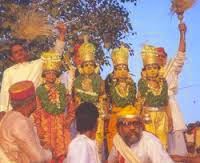
Raamlila: The theater of God

Raamcharitmanas by Tulsi Das, sacred text devoted to the glory of Rama, is an incomparable compilation and a lot more than a text. It just not present the story of a Tretayug figure's character "Ramacharit" but also relate it to the present world's "manas". Its dramatic folk re-enactment "The Ramlila" is a celebration of victory of truth over evil. Ramlila, literally Rama's play, is a performance of then Ramayana epic in a series of scenes that include song, narration, recital and dialogue. It is performed across northern India during the festival of Dussehra, held each year according to the ritual calendar in autumn. 
Historically it is believed that first Ramlila shows were staged by Megha Bhagat, one of the disciples of Tulsidas in about 1625 AD, though there are some evidence of its existence in some form before the creation of this version as well.
The most representative Ramlilas are those of Ayodhya, Ramnagar at Benares, Vrindavan, Almora, Sattna and Madhubani. This staging of the Ramayana is based on the Ramacharitmanas, The majority of the Ramlilas recount episodes from the Ramacharitmanas through a series of performances lasting ten to twelve days, but some, such as Ramnagar's, may last an entire month. Festivals are organized in hundreds of settlements, towns and villages during the Dussehra festival season celebrating Ramas return from exile. Ramlila recalls the battle between Rama and Ravana and consists of a series of dialogues between gods, sages and the faithful. Ramlilas dramatic force stems from the succession of icons representing the climax of each scene. 

The audience is invited to sing and take part in the narration. The Ramlila brings the whole population together, without distinction of caste, religion or age. All the villagers participate spontaneously, playing roles or taking part in a variety of related activities, such as mask- and costume making, and preparing make-up, effigies and lights. However, the development of mass media, particularly television soap operas, is leading to a reduction in the audience of the Ramlila plays, which are therefore losing their principal role of bringing people and communities together.

UNESCO proclaimed the tradition of Ramlila a Masterpiece of the Oral and Intangible Heritage of Humanity in 2005. Subsequently, Govt. of India and IGNCA produced a two-hour documentary, titled "Ramlila - The traditional performance of Ramayana" for UNESCO, on 'Ramnagar Ramlila', and Ramlila traditions of Avadh, Braj and Madhubani, and that of Ayodhya, which assimilates elements of all three. Another unique Ramlila, is being staged since 1972, at Bakshi Ka Talab, about 20 km from Lucknow, where lead characters like Rama, Lakshman and Hanuman are played by Muslim youths, a clear departure in a region known for communal flare-ups; this four-day Ram Lila starts on the day of Dusshera day, and has also been adapted into a Radio play, 'Us Gaon ki Ram Lila', by Lucknow All India Radio, which won the Communal Harmony Award in 2000.