India's is an amazing land of colors, cultures, arts, music, songs and knowledge. It is impossible to make an exhaustive and inclusive list of Her art forms.
The intricate classical music with its artistic & spiritual beauty has divine powers. On the other hand, the simplicity of the folk songs, independent of languages, has intense intoxication.
This blog is intended to introduce various classical and folk art-forms of India to evoke love and liking for this music.
Kabīr, (born 1440, Varanasi; died 1518, Maghar), iconoclastic Indian poet-saint revered by Hindus, Muslims, and Sikhs alike.
Kabir was initiated by Swami Ramananda- a major exponent of Vishishtadvaitaphilosophy who considered lord Rama as Iṣṭa-devatā. Kabir too often refers to Ramaas his lord. He did not become a sadhu, nor did he entirely abandon worldly life. Kabir chose instead to live the balanced life of a householder and mystic, a tradesman and contemplative. However, there are conflicting views of whether he actually entered into a formal marriage or not.
Kabir's family is believed to have lived in the locality of Kabir Chaura in Varanasi. Kabīr
maṭha (कबीरमठ), a maṭha located in the back alleys of Kabir Chaura, celebrates his life and times. Accompanying the property is a house named Nīrūṭīlā (नीरू टीला) which houses Niru and Nima's graves. The house also accommodates students and scholars who live there and study Kabir's work.
Kabir's legends describe his victory in trials by sultan, a Brahmin, a Qazi, a merchant and God. The ideological messages in Kabir's legends appealed to the poor and oppressed. David Lorenzen describes primary purpose of his legends as a "protest against social discrimination and economic exploitation".
His greatest work is the Bijak (the "Seedling"), an idea of the fundamental one.
This collection of poems elucidates Kabir's universal view of spirituality. Though his vocabulary is replete with Hindu spiritual concepts, such as Brahman, karma and reincarnation, he vehemently opposed dogmas, both in Hinduism and in Islam. He often advocated leaving aside the Qur'an and Vedas and simply following Sahaja path, or the Simple/Natural Way to oneness in God. He believed in the Vedantic concept of atman, but unlike earlier orthodox Vedantins, he spurned the Hindu societal caste system and Murti-pujan (idol worship), showing clear belief in both bhakti and Sufi ideas.
Kabir calls his God by the name of Rama. However, his Rama is not the Rama of Ayodhya born of Dashratha. His Rama is Niranjan (without taint), Nirakar (formless) and Nyara(omnipresent, extraordinary). Here, his views are in line with the best ideals exposed in the upanishads.
His Hindi was a vernacular, straightforward kind, much like his philosophies. A major part of Kabir's work as a bhagat was collected by the fifth Sikh guru, Guru Arjan Dev, and incorporated into the Sikh scripture, Guru Granth Sahib. The hallmark of Kabir's works consists of his two line couplets, known as the 'Kabir ke Dohe'.
Kabir's poetry today:
There are several allusions to Kabir's poetry in mainstream Indian film music. The title song of the Sufi fusion band Indian Ocean's album Jhini is an energetic rendering of Kabir's famous poem "The intricately woven blanket", with influences from Indian folk, Sufi traditions and progressive rock.
Noted classical singer, late Kumar Gandharva, is widely recognized for his wonderful rendering of Kabir's poetry.
Prahlad Singh Tipaniya is an Indian folk singer who performs Kabir bhajans in the Malwi
He is associated with The Kabir project, which brings together the experiences of a series of ongoing journeys in quest of this 15th century north Indian mystic poet as well as other Bhakti and Sufi poets in our contemporary worlds. Started in 2003, these journeys inquire into the spiritual and socio-political resonances of Kabir’s poetry through songs, images and conversations.
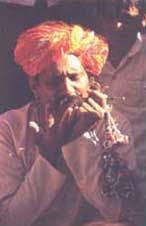
Music of Rajasthan originates from Rajasthan, one of the states of India and home to several important centers of Indian musical development, including Udaipur, Jodhpur and Jaipur. The region's music shares similarities both with nearby areas of India and the other side of the border, in the Pakistani province of Sindh. Instruments of Rajasthani Folk:
Ocean of Melody is a two-part documentary that delves into the key aspects that construct the framework of Indian classical music vis a vis its two forms: Hindustani and Carnatic. The Film explores the fluidity that these forms of music allow within a well-defined structure – one that is derived intrinsically from constant improvisations by the performer. Introducing the practical aspects of music like the swara and how their interplay over time created structures and formats in the form of Ragas, the narrative goes on to elaborate on the various presentation forms or GayanShailis, examine the relationship shared by the master and the disciple in the backdrop of what is known as the age old guru shishyaparampara or baniand also understand the emotions associated with music as an art form - a certain luminosity and peace, stillness, beauty and reverence. The essence behind the elevation to a spiritual realm that exponents often find themselves in after years of practice and penance- a tenet that keeps the form pure and timeless is also explored.
Bismillah Khan (Urdu: استاد بسم اللہ خان صاحب; 21 March 1913 – 21 August 2006), often referred to by the honorific title Ustad, was an Indian musician credited with popularising the shehnai, a subcontinental wind instrument of the oboe class. While the shehnai had long held importance as a folk instrument played primarily during traditional ceremonies, Ustad ji is credited with elevating its status and bringing it to the concert stage. He was awarded India’s highest civilian honour, the Bharat Ratna, in 2001, becoming the Third classical musician after M. S. Subbulakshmi and Ravi Shankar to be accorded this distinction.
Bismillah Khan was perhaps single-handedly responsible for making the shehnai a famous classical instrument. He brought the shehnai to the center stage of Indian music with his concert in the Calcutta All India Music Conference in 1937. He was credited with having almost monopoly over the instrument as he and the shehnai are almost synonyms.
Ustad ji is one of the finest musicians in post-independent Indian classical music and one of the best examples of Hindu-Muslim unity in India. He played the shehnai to audiences across the world. He was known to be so devoted to his art form that he referred to shehnai as his begum (wife in Urdu) after his wife died. On his death, as an honour, his shehnai was buried with him. He was known for his vision of spreading peace and love through music. “ Even if the world ends, the music will still survive. ” “ Music has no caste. ”
Ustad ji lived in the holy city of Benaras, situated on the banks of the river Ganges..A documentary 'Bismillah and Banaras' traces the symbiotic relationship between the Shehnai maestro Bismillah Khan and the city of Benaras. As a young boy, Bismillah would play the Shehnai everyday at the Kashi Vishwanath temple - a tradition that he continued over the years. In his travels across the world, Bismillah remarks that his eyes are capable of seeing and imagining only Benaras. Bismillah Khan was awarded the Bharat Ratna award for his contribution to the world of Indian classical music and for raising the status of the Shehnai to the level of a concert instrument. This film is a tribute to the sheer genius of a musician and also his love for the city of Benaras.
Jugni is an age-old narrative device used in Punjabifolk music and sung at Punjabi weddings in India, Pakistan, US, Canada, Australia and UK. The word literally means 'Female Firefly', in folk music it stands in for the poet-writer who uses Jugni as an innocent observer to make incisive, often humorous, sometimes sad but always touching observations. In spiritual poetry Jugni means the spirit of life, or essence of life. The late Legendary Alam Lohar (Punjab, Pakistan) and late Singer & Humorist Asa Singh Mastana (Punjab, India) are credited with popularizing this poetry from early Sufi spiritual writings.
Balle Balle (Punjabi: ਬੱਲੇ ਬੱਲੇ, Hindi: बल्ले बल्ले, Urdu: بلّے بلّے) is a phrase used in many Punjabi songs to depict a feeling of happiness. It does not have an exact translation and would be used in the same way as the English expressions, "Hooray!!" or "Hurrah!". Balle Balle is a Punjabi expression used while enjoying things. It is an expression of joy.
Malhar is an old raga in Indian classical music. Malhar is associated with the atmosphere of torrential rains. Besides the basic Shuddha Malhar, which was the original Malhar, there are several Malhar-related ragas that use the Malhar signature phrase m (m)R (m)R P, including Miyan Malhar, Ramdasi Malhar, Gaud Malhar, Sur Malhar, Des Malhar, Nat Malhar, and Meera ki Malhar. According to legend, raga Malhar is so powerful that when sung, it can induce rainfall. It is possible that the rainfall that the legends speak of is in fact metaphorical of the state of mind brought about by the recital of the raga.
There are many written accounts of Raga Malhar. Many great artists of the medieval period and much earlier periods used to sing this raga. Tansen, Baiju Bawra, Baba Ramdas, Nayak Charju, Miyan Bakhshu, Tantarang, Tanras Khan, Bilas Khan (son of Tansen), Hammer Sen, Surat Sen, and Meera are among the singers who are said to have been capable of starting rains using various kinds of Raga Malhar.
According to a legend, once the Mughal emperor Akbar asked his court musician Tansen to sing Raga Deepak, the raga of fire. The effect was such that all the lamps in the courtyard lit up themselves, and Tansen's body became so hot that he had to sit in the nearby river to cool himself. However, the river began to boil, and it became apparent that Tansen would soon boil to death. He set out on a search to find someone who could sing Raga Malhar to cure him. In due course he reached Vadnagar, in Gujarat, where he found two sisters, Tana and Riri, whom he asked for help. They agreed to sing Raga Malhar to cure him. When they sang the Raga, rains came down in torrents, which cooled Tansen's body immediately.
Bharata Natyam (Tamil: பரதநாட்டியம்) also spelled Bharatanatyam, is a classical Indian dance form that originated in the temples of Tamil Nadu. This dance form denotes various 19th- and 20th-century reconstructions of Sadir, the art of temple dancers called Devadasis. It was described in the treatise Natya Shastra by Bharata around the beginning of the common era. Bharata Natyam is known for its grace, purity, tenderness, and sculpturesque poses. Lord Shiva is considered the God of this dance form. Today, it is one of the most popular and widely performed dance styles and is practiced by male and female dancers all over the world. Bharata Natyam is considered to be a fire-dance — the mystic manifestation of the metaphysical element of fire in the human body. It is one of the five major styles (one for each element) that include Odissi (element of water), Kuchipudi (element of earth), Mohiniattam (element of air) and Kathakali (element of sky or aether). The movements of an authentic Bharata Natyam dancer resemble the movements of a dancing flame. Contemporary Bharata Natyam is rarely practiced as Natya Yoga, a sacred meditational tradition, except by a few orthodox schools.
Bharata Natyam is the manifestation of the ancient idea of the celebration of the eternal universe through the celebration of the beauty of the material body. Some Bharata Natyam techniques can be traced back to the Kaisiki style. The Natya(I.44) reads, "... I have seen the Kaisiki style during the dance of the blue-throated lord (Shiva). It consists of elaborate gestures (Mridu Angaharas, movements of limbs), sentiments (Rasas), emotional states (Bhavas). Actions (Kriyas) are its soul. The costume should be charmingly beautiful and love (Sringara) is its foundation. It cannot be adequately portrayed by men. Except for women, none can practise it properly".
Apart from the Kaisikii style, Bharata Natyam imbibed some others. These reflect other yogis of spiritual revelations, such as the vision of two sages, Vyagrapada and Pathanjali in Chidambaram. In Hindu mythology the whole universe is the dance of the Supreme Dancer, Nataraja, a name for Lord Shiva, the Hindu ascetic yogi and divine purveyor of destruction of evil. The symbolism of the dance of Shiva (in the form of Nataraja) is represented by the attitude called "Ananda Tandavam".
Also known as the cosmic dancer, he is here the embodiment and manifestation of the eternal energy in five activities (panch-kriya): creation, pouring forth, unfolding; maintenance or duration (sthiti); destruction or taking back (smhara); concealing, veiling, hiding the transcendental essence behind the garb of apparitions (tirobhava); and favoring, bestowing grace through a manifestation that accepts the devotee (anugraha). Shiva is depicted dancing on the dwarfish body of the demon Apasmara purusa, "forgetfulness, loss of memory" who represents ignorance, the destruction of which brings enlightenment, true wisdom, and release from the bondage of existences.

.jpg)
.jpg)




.jpg)


.jpg)